Monday, October 30, 2006

Bossa Filipino

Bong Penera - A Samba Song Penny Rose TSP-5190 (Phil) (1974)

A SAMBA SONG is Bong Penera’s debut album. A Samba Song – as bright as the sunny weather of Manila, is one of the earliest compositions of Bong Penera with the Batucadas. This tune is further given an infectious flow with Brazilian guest Singer Maria Dulce Soares Da Silva singing it in her native language. Copyright is 1974 and produced by Penny Rose Production, the back cover has a short story about the album written by Ding Quejada.

When in 1968, Bong Penera organized a jazz ensemble called the "Shades of Latin" there were certain forces which collaborated to dismiss jazz as a popular idiom as no more than an afterthought of the Existential Satre confined to a numbered few. There was no market for jazz or particularly for the Brazilian bag. And yet in was during these times that Sergio Mendes and Brasil '66 took the South American fever with them to Intercon and Astrud Gilberto to Sheraton and Gary Burton to workshops. Sadly though, one had to be moneyed to see them, understandably, an elitist sect was the only target and type of audience that could patronize jazz. The "Shades of Latin" played at Carbungco’s in Quezon City and in private parties whose people knew Jobim, Badin Powell, Mendes & Walter Wanderley. Eventually, as commercial music surged higher in the charts and the vitality of bossa nova or jazz was getting down under such groups as the "Shades…." had to stop and give way to the trends. The parties soon disappeared including the Carbanco stint, soon it seemed to have been announced that jazz has gone and that the "Shades…" have vanished to obscurity.

But despite the obstacles and brave enough to cross the currents of commercialization, Penera organized the BATUCADA in 1973 and rapidly made it to the top, a rise which he himself did not expect and which music critics describe as "Phenomenal." Perhaps the audience has matured or the trends have changed but whichever reason, concert after concert, performance after performance, the Batucada drew raves and ovations. Bong first involved his Batucada into the jazz revival movement at the Extension with his good friends Lito Molina & Co. and what happened afterwards is history. Offers for nightclub dates, travel abroad and recordings, television performances, movies scores and concerts soon came, Today, Bong Penera & the Batucada is practically the only jazz group that actually made it while using the Brazilian idiom. But why Brazilian? One may ask. Or what accounts for the wide appeal of the Batucada? What brings the jazz buffs to pack at Pension Filipina, Bacchus Pub and Batik Inn?

Firstly, the Batucada is probably the only jazz group that could remain a trio and still retain the sound of a full band. It’s a tease in a way and its diminutive size has baffled many. It plays music that is versatile, universal and certainly rhythmic. Of all the elements that make up the art we know as music, the most fundamental is rhythm. The pulse, the beat—this is the foundation of it all, natural and inevitable, growing out of life itself. The cycle of night and day, the turning seasons of the years, the beat of one’s heart, the steady pace of one’s footsteps, these things are always with us, we are surrounded by rhythm. Thus explains Bong as he points out the particular adherence to the Brazillian idiom and as to why he chose the name "Batucada" which means, "beat." Their music is just it –pulsating, never giving too much or forcing too much, sometimes aggressive, sometimes funky, or soulful and seasoned with sophistication and a case definitely beyond their years. There are depth but not the kind that is confined to the intellectual alone, and there is the dynamic creativity evident in their performances: not one piece is repeated exactly the same as it was first played. There is always something new to look forward to. This is obviously the reason why Bong’s concerts have always been full packed: the Thomas Jefferson Cultural Center had to drive away people for lack of room. The UP Los Banos Concert had to go on for three hours instead of the original one and half, or why the Phil-am life concert had to have a repeat.

The Brazillian syndrome with which Bong Pinera & the Batucada grew and permeated the local jazz scene is an act definitely arduous to follow. Their music rose out of pure talent and creativity devoid of any limitation so characteristic of our local jazz bands. Pong Penera is unique by and in himself. He is certainly an accomplished musician and one of the most gifted. He is of course many things too, being a poet, playwright, essayist, professor, painter all rolled into one. He plays guitar quite well and is gifted with an intimate, sensitive and poetic singing voice. His band aptly called the "Batucada" is also unique, Sonny Nabong plays bass, Nick Boogie is on percussion and Ding Poblete is on drums. And all these guys swing and sway with the Brazillian spirit you think that were imported from Rio. As you can see in this album. The girl who sings the Portuguese lyrics of the title tune is a Brazilian who goes by the name of Maria Dulce Soares de Silva, while Norina Ramirez does the English version. The fine supporting flute lines belong to Pete Canson.

This is Bong Penera’s first album (probably the first local jazz album) and he‘s naughty enough to pave packed only 10 songs. The feeling it leaves the listener is that of being "biten" and its goddamn great for a maiden LP.

1) A Samba Song
2) A Tear For Sunrise
3) Wordless
4) Longing
5) Rosita Maria
6) Beat Contemplation
7) Afraid To Be Known
8) And I Will Sing
9) Samba Madrugada
10) A Samba Song No. 2

Friday, October 27, 2006

Eclectic Elek Tricks

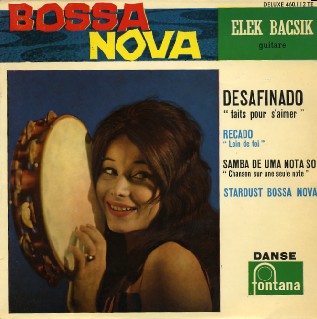
Elek Bacsik - Bossa Nova Fontana 460.112 TE (Fra) (1962)

Hungarian guitarist Elek Bacisk was a cousin of Django Reinhardt, but as Bacsik reminded Leonard Feather "we gypsies are all related!" and continued his tradition of blending swing and gypsy elements into a coherent, expressive jazz mode.

Bacsik initially studied classical violin and played gypsy songs in Budapest, then switched to jazz guitar. [In 1975 he recorded a violin album "Bird and Dizzy"]. As a teen, he recorded in a band with alto saxophonist Gabor Szabo and trumpeter Jozsef Quitter, then later toured Europe with Mihaly Tabanyi's band.

Bacsik moved to Paris in 1959, and through the early and mid-'60s recorded and played with visiting American musicians, among them Art Simmons, Quentin Jackson, Lou Bennett and Dizzy Gillespie. He also did sessions heading his own bands. Bacsik emigrated to America in 1966, and worked from 1967-1974 with Teresa Brewer before cutting his own sessions. He appeared at the 1974 Newport Jazz Festival and 1984 Olympic Games Jazz Festival in Los Angeles.

Elek was born in 1926 into a Hungarian gypsy family. He studied the violin at the Conservatory in Budapest but taught himself the guitar and went on to play jazz in Switzerland and France where he played with Dizzie Gillespie.

In 1962 he recorded a LP as leader "The Electric Guitar of the Eclectic Elek Bacsik". On this album his style displays a much closer affinity to Tal Farlow and Johnny Smith than the European gypsy genre where he overdubs a second, mainly rhythm guitar part.

In 1966 he moved to the USA but became submerged in the cabaret scene in Las Vegas. As Leonrad Feather puts it in his liner notes to "Eleck Bacsik: Bird & Dizzy" (Flying Dutchman) 75: "Bacsik was philosophical about the contrast of the matchless talent he displays here [on violin] and the total anonymity of his life in Las Vegas, where he has lived since 1967. "I spent a couple of years at the Riviera Hotel; moved around from one casino to another for a year; spent four years at the Hilton, and for the past year I've been at the Sahara". Asked whether he had ever had a chance to express himself in that so-called entertainment capital of the world, Bacsik promptly replied "No way!" I'd like to play some jazz club, and let the jazz audience hear me at some festivals".

In 1973 he began working with Bob Thiele and released two more LPs as well as playing at the Newport Festival. But just as this seemed to be bringing him to public attention once more he faded back into the shadows. He died in 1991 largely forgotten by the jazz community.

1) Desafinado ''Faits Pour S'aime''
2) Recado ''Loin De Fol''
3) Samba De Una Nota ''Chanson Sur Une Seule Note''
4) Stardust Bossa Nova

Tuesday, October 24, 2006

Sound Clips?

Am playing around with various audio extras to offer u guys. You should hear a brief preliminary sample as this page loads (don't worry - it won't loop you to insanity!).
What say you? On-demand sound samples from forthcoming posts/regularly updated background music? All feedback gratefully received.
My regards to you all...

Filó

Filó Machado - Filó Chantecler 2.08.404.102 (1978)

Singer, composer, multi-instrumentalist, arranger and producer Filó Machado was born in Ribeirão Preto (São Paulo) in 1951, on February 3rd. He started working as a singer in clubs when he was ten years old.

He has appeared with the most illustrious artists in international music such as Michel Legrand, Paul Mauriat, Jon Hendricks, Jane Duboc, Ivan Lins, Leny Andrade, Tito Madi, Joyce, Hermeto Paschoal, Johnny Alf, & Flora Purim to name but a fraction!

This, his debut album recorded in 1978 displays a variety of styles and is a hugely enjoyable listen boasting a handful of sultry & bouncy club tunes. In addition Aluizio Pontes & Roberto Sion add to the feel-good factor. Enjoy...

1) O Polvo
2) Viver E Sonhar
3) Tigre De Bengala
4) Ponta De Faca No Peito
5) Fatos Da Visao
6) Menino Diabo
7) Velha Cidade
8) Gira Sol
9) Pindorama
10) Ascensao

Tuesday, October 17, 2006

Jayme Marques

Jayme Marques RCA SPL1-2453 Spain (1976)

Jayme Marques was born in Campo Grande, capital of Mato Grosso del Sur, Brazil on June 12th 1936. After moving to Sao Paulo at 20, he arrives in Europe and soon to be homeland of Spain where he becomes musical director of La Orquesta Orfeo.

Notable jazz guitarist, composer and singer, Jayme Marques has collaborated with the likes of Augusto Algueró, Pedro Iturralde, Tete Montoliu, Ramon Farran. and Paco de Lucía, with who he fused flamenco with Brazilian music.

He has accompanied in world-wide tours such artists as Jacques Brel and Maysa Matarazzo, as well as sessions with Thad Jones, Lionel Hampton & Pat Metheny. He was largely responsible in introducing Bossa Nova and Samba to Europe.

Marques maintains his residence in Spain and in 1965 he moves to Palma de Mallorca where he he resides for 20 years, collaborating with Serrat, Josefine Baker, Tom Jones and Matt Monro. Creator of La Balerar Big Band, Marques ends his stay on the island directing the spectacular “In Memorian A Duke Ellington”. He then moves to Madrid where he lives at the moment, collaborating with Spanish television TVE.

This rare LP was produced & recorded exclusively for TVE for the Saturday TV program “Directísimo” in 1976. Presenter Jose Maria Iñigo personally requested Jayme Marques perform in the program, for which the musician prepared the tunes that appear on this record.

With great musicians like Rafael Ferro (keyboards), Pedro Iturralde (tenor sax and flute), Tito Duarte (percussion) & Pepe Sanchez (drums), this is an eclectic treat for lovers of jazz funk, big band jazz & bossa!

1) In The Mood
2) Dark Orchid
3) Boato
4) This Way
5) Balada
6) Little Brown Jug
7) Summertime
8) Garota De Ipanema
9) My Friend Willie
10) U.S.

Tuesday, October 10, 2006

Jazz Q

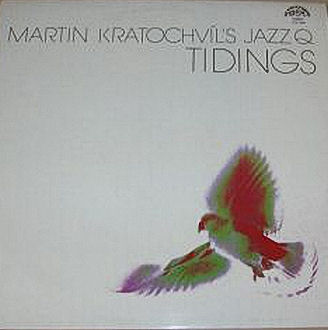
Martin Kratochvil's Jazz Q - Tidings Supraphon 1115 2450 (1977)

Czechoslovak organist, pianist, composer and successful owner of the BONTON label was a pioneer in the use of electronic keyboards and computers in music. In 1965, he founded his first amateur jazz group, the Jazz Q, a member of which was the well known flutist Jiri Stivin. But Jiri left the formation in 1970, when Martin changed his musical orientation, heavily influenced by the likes of Chick Corea and John McLaughlin.

Along with Martin's keyboards the band's setup here comprised Lubos Andrst on guitar, Premysl Faukner on bass and Jaromir Helesic on drums. Here's a nice slice of Eastern European funky jazz-fusion, recorded in Praha/Czech Republic in 1977.

1) The Bed-Time Witch
2) Resurrection
3) Footprints
4) Allegory
5) Icicles
6) Weathercock
7) Diamonds
8) Happy-Go-Lucky

Wednesday, October 04, 2006

'Harper'

Johnny Mandel - Harper Mainstream S-6078 (1966)

This is a different kind of cat named Harper... and excitement clings to him like a dame!

Private eye Lew Harper shows up early at the Southern California estate of Elain Sampson. She offers a drink, he declines, "I thought you were a detective," she says. "New type," Harper answers. Paul Newman memorably plays that new type in Harper, based on Ross MacDonald's The Moving Target. The first detective film in Newman's then 23-film career (he later reprised Harper in The Drowning Pool), Harper revitalized the genre. Newman's sleuth chews gum fast...and slips out of jams even faster as he unravels a twisted case of kidnapping and murder. William Goldman's clever screen-play throws quips and a parade of LA-LA-Land characters Harper's way. There's a woman of means (Lauren Bacall), a gun-toting attorney (Arthur Hill), a poolside gigolo (Robert Wagner), a boozy ex-starlet (Shelley Winters), a jazz junkie (Julie Harris), Harper's estranged wife (Janet Leigh) and the unholy order of the Temple of the Clouds (led by Strother Martin). Each may possess a clue. Or a bullet for Harper.

For me, this soundtrack has it all. A groovy main theme, a couple of cracking vocal numbers by Ruth Price and soul superstar Sam Fletcher, beautiful jazz ballads penned and played by Andre Previn and the obligatory mod-swinging crime tunes. A really great listen all the way through, the epitome of cool!

1) Harper (Main Title)
2) Quietly There
3) Magnus Cum Louder
4) Livin' Alone
5) Harper Does It Better
6) Mexican Breakfast
7) Sure As You're Born
8) Harper's Ferry
9) Temple Of The Clouds
10) Bel Air
11) Finale (Susan)


Tuesday, September 26, 2006

Nova Bossa 4

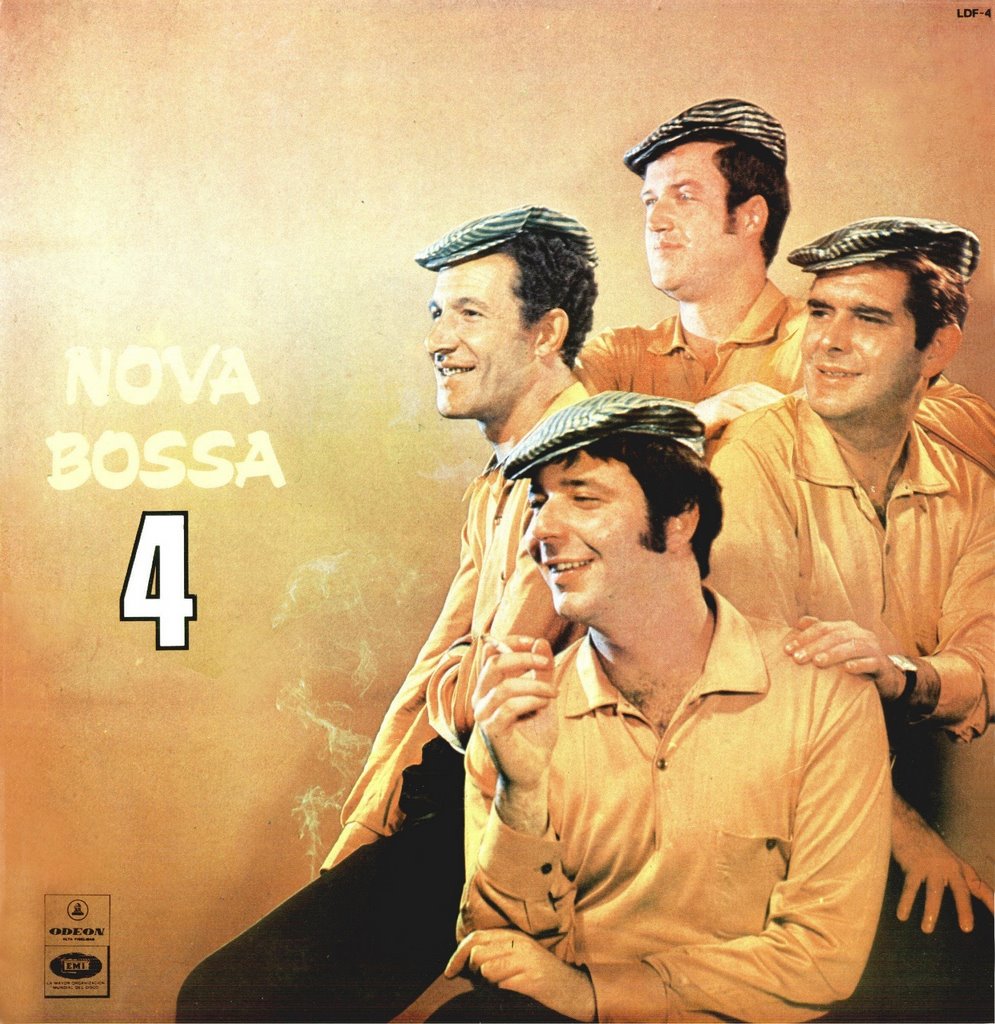
Nova Bossa 4 - 'Self Titled' Odeon LDF-4378 (1969)

Download now, ask questions later! Some terrific bossa vocals here courtesy the obscure Nova Bossa 4 out of Argentina. Groovy harmonies with the odd psyche touch, dig the infectious organ led 'Muchacho De Moda'. Quality all the way...

1) Asegura Este Samba (Ogunhe)
2) Insensatez
3) Mi Bien (Meu Bem)
4) Muchacho De Moda (Rapaz De Moda)
5) Andante (Si Manda)
6) Tristeza
7) El Teléfono (Telefone)
8) El Grande Amor (O Grande Amor)
9) Queda Mal Con Dios (Fica Mau Com Deus)
10) El Día Que Lloré (O Dia Que Chorei)
11) Canto
12) Llorando Por Mí (Chorando Por Mim)

Wednesday, September 20, 2006

Wlodzimierz Nahorny

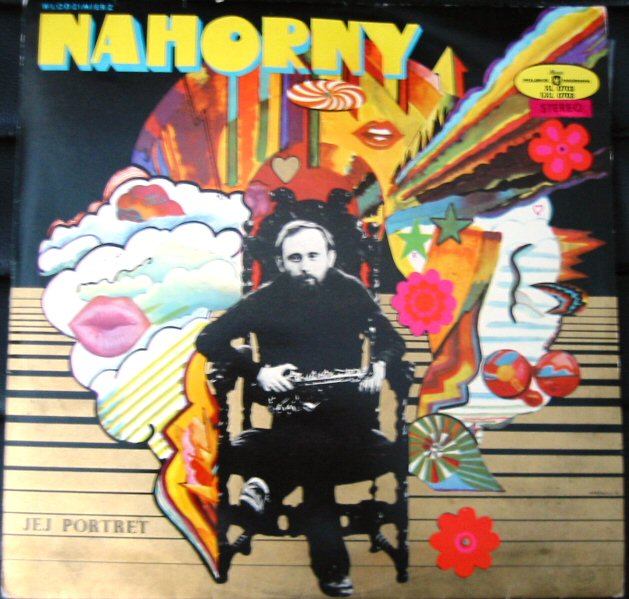
Wlodzimierz Nahorny - Jej Portret Muza SXL-0703 (1970)

Pianist, saxophonist, flautist, arranger and film composer, Polish Jazz legend Wlodzimierz Nahorny was born in 1941 and made his debut on stage in 1959. The ubiquitous Nahorny is to be found on many of the most important Polish jazz recordings and similarly graced many a star-studded festival line-up throughout Europe, U.S. & Asia during the sixties and seventies. In 1966 he received a prestigious modern jazz laureate in competition in Vienna.

The Polish Muza record label is a firm favorite of mine, with a dazzling output of both traditional and like this album timeless modern jazz classics. This fine LP boasts many nice tunes and has a dreamy, melancholic flavour but nevertheless that vital component so essential in meriting a post on this blog. The highlight for me being the laid-back groove of the 'Hole In The Ground' theme.

1) Jej Portret (Her Portrait)
2) Powiedzielismy Juz Wszystko (We've Said Everything)
3) Cala Jestes W Skowronkach (There Are Skylarks All Over You)
4) Melodia Z Filmu ''Dziura W Ziemi'' (Theme From The Motion Picture ''Hole In The Ground'')
5) Taki Dzien (What A Day)
6) Mowily Mu (They Told Him)
7) Niech Pan Mi Nie Odslania Wnetrza (Leave Me Alone)
8) Wroce Do Ciebie (I'll Be Back)
9) Jest Warszawa (But Warsaw Still Is)
10) Obok Nas (Beside Us)
11) Wlasnie Tego Dnia (This Very Day)
12) Trzymajac Sie Za Rece (Holding Hands)

Monday, September 18, 2006

Update!

Sorry for the lack of updates recently I have been out of the country. Stay tuned for more of the good stuff...

Wednesday, August 23, 2006

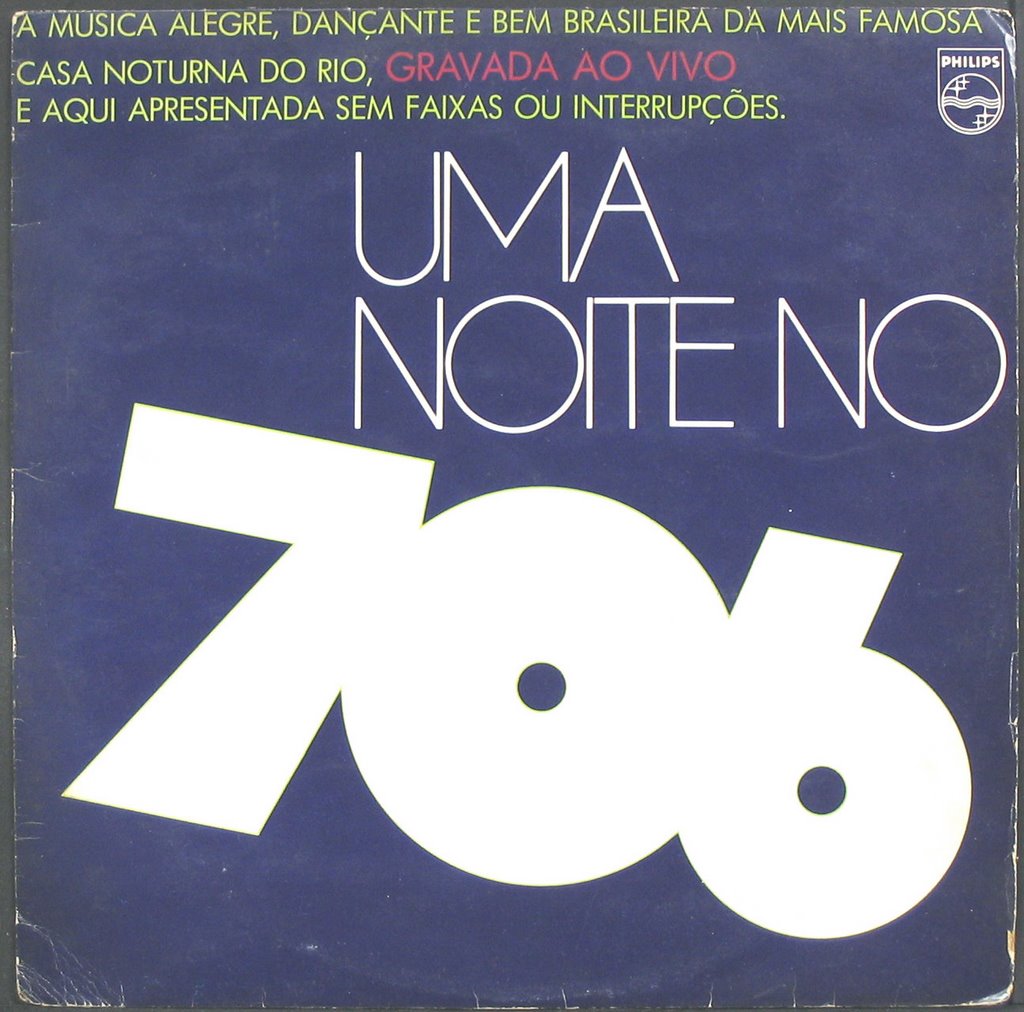
A Night In The '706' Club

Eduardo Prates e Seu Conjunto & Fernando Martins e Seu Conjunto - Uma Noite No 706 Philips 6349.336 (1977)

This will satisfy lovers of Fender Rhodes led jazzy bossa. Lots of funky tunes here awash with groovy male & female vocals.

This session was recorded live at the "706" club in Rio and features a side each by Eduardo Prates & Fernando Martins with their respective groups.

Side A - Eduardo Prates e Seu Conjunto
1) Vai Levando
2) Papo Furado
3) O Que Vier Eu Traco
4) Bambo Do Bambu
5) Ajoelha
6) Partido Rico
7) Te Segura
8) Recordacoes De Um Batuqueiro
9) Voce Vai Ver

Side B - Fernando Martins e Seu Conjunto
1) Adeus, America
2) Rock-Enredo
3) Acreditar
4) Outro Amor
5) Jesuino Galo Doido
6) Antes Ele Do Que Eu
7) Perdoa
8) Maracatu Atomico

Wednesday, August 02, 2006

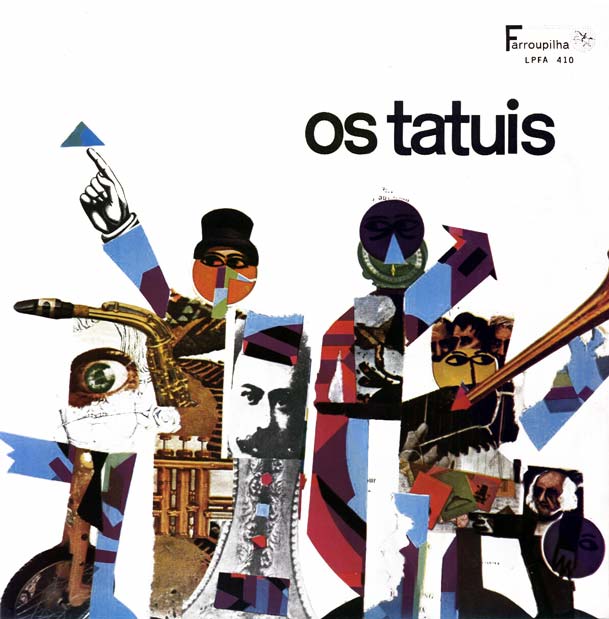
Os Tatuis

Os Tatuis - Os Tatuis Farroupilha LPFA-410 (1965)

Yet another early Bertrami brothers project, also known as Azymuth!. Here's a the slickest bossa jazz, the group's forward thinking arrangements are already self-evident on this perfectly realised album.

Os Tatuis are led by Jose or Ze Roberto on piano & Claudio Henrique on bass, the remainder of the group comprising Og Vasconcelos on Sax, Ivo Mendes on trumpet, Elizeu de Campos Vieira on drums with Aresky Aratto also on keys.

1) Vivo Sonhando
2) Nuvens
3) Inutil Paisagem
4) Voce
5) A Morte De Um Deus De Sal
6) Insensatez
7) A Bossa Do Ze Roberto
8) Primavera
9) Samba Do Aviao
10) Sou Sem Paz
11) Minha Namorada
12) O Menino Das Laranjas

Wednesday, July 26, 2006

A Musica De Briamonte

José Briamonte - Sambeco, A Musica De Briamonte RCA Victor BBL-1449 (1968)

Probably the rarest LP by this legendary songwriter, arranger & pianist. His talents often grace the grooviest sixties' bossa releases and this album is no exception.

Joined by the likes of Papudinho on trumpet, Raulzinho on trombone, Heraldo do Monte on acoustic guitar, Capacete & Guará on acoustic bass, Garoto on vibes, Chacau & Heitor on drums & percussion and Boneca on acoustic guitar.

Whether it's tight snapping jazz instrumentals or groovy bossa vocals, each tune is propelled in Briamonte's trademark swinging fashion - and with songs penned by Alan & Marilyn Bergman, Quincy Jones, João Donato, Luiz Carlos Vinhas, Milton Nascimento & Johnny Alf, as well as Briamonte himself, it's a great listen all the way through!

1) Roda De Samba
2) Selva
3) Moça
4) The World Goes On
5) Canto Pra Amada
6) Eu E A Brisa
7) Mr. King
8) Travessia
9) Watch What Happens
10) Januaria
11) Sonho Bom
12) Ye Me Le

Wednesday, July 12, 2006

Inner City Summer

Here's a compilation of lesser known summery jazz fusion tunes all taken from the U.S. Inner City label and are of a late seventies vintage. I did this one for personal consumption but thought you might enjoy it, so here it is with suitable cover art.

If there are enough takers, I'll post the second volume at a later date.

1) Sam Morrison - Song Of Landa
2) Arn Evans + Tradewinds - Song For The Changing Seasons
3) Jeff Lorber Fusion - Chinese Medicinal Herbs
4) Listen Featuring Mel Martin - Growing
5) Dry Jack - Heads In The Cloud
6) Solar Plexus - The Darwin Dilemma
7) Bert Ligon - River Journey
8) Didier Lockwood - Aspiring Answer
9) Cybill Shepherd - Triste
10) Kellis Ethridge - Pensacola Joy
11) Arni Egilsson - Hot Air On A G String

Monday, July 03, 2006

Guitarra Cósmica


Sebastião Tapajós - ... E Sua Guitarra Cósmica Forma VDL-114 (1969)

Sebastião Tapajós is a renowned Brazilian musician with over 50 recorded albums. A classically-trained violonista (acoustic guitar player), he soon awakened to his own musical expression, which bridges the gap between the rich Brazilian tradition and the delicacy, subtlety, and sophistication of the classical tradition. He received more than 20 awards in his career, including Germany's Album of the Year. Touring intensively through Europe, he has played and recorded with Gerry Mulligan, Astor Piazzolla, Oscar Peterson, Paquito de Rivera, Zimbo Trio, Hermeto Pascoal, and many others, with concerts attended by more than 600,000 people.

His father, who was his first teacher, prompted him to begin playing at nine. He continued to study as a self-taught, until he moved to Belém, in Pará, Brazil, studying musical theory with Professor Drago. In 1963, he moved again, this time to Rio, where he studied with Othon Salleiro. In 1964, he moved to Portugal, where he graduated from the Lisbon National Music Conservatory. Tapajós was already an active performing artist, performing concerts in Portugal and Spain. In Madrid, he studied with guitar master Emilio Pujol, having graduated from the Hispanic Culture Institute. Since 1968, his recordings have been released in Brazil, Argentina, Japan, and in most European countries. Returning to Belém, he spent some time there before moving again to Rio, in search of performing opportunities and at the same time researching Brazilian popular music. The first opportunity to perform came with a rendition of Villa-Lobos' "Concerto for Guitar and Orchestra," together with National Symphonic Orchestra, at the Teatro Municipal, Rio's most distinguished classical music concert house. The critics were very favorable, and he began to tour Brazil and the U.S., giving concerts. By and by, Tapajós began to demonstrate interest in writing Brazilian popular music. His compositions, always evidencing an original character while avoiding easy commercial references, are profoundly rooted in Brazilian tradition. In 1972, his Brasil/El Arte de la Guitarra was released by Discmedia/Trova-Alfa, with themes from classical and popular Brazilian composers, and his own compositions, together with a Weiss piece, "Allemande." After 1973, he toured Europe with great success. In that same year, he performed at the Folklore and Bossa Nova of Brazil Festival, accompanying Maria Betânia and Paulinho da Viola, and he recorded Bienvenido Tapajós for MPS. He then began an intense touring schedule through Germany, Austria, Denmark, Norway, Italy, Holland, Belgium, and other countries. He also makes a point in presenting to his European audiences other great Brazilian musicians, such as Maurício Einhorn, Zimbo Trio, Joel do Bandolim, Djalma Correa, Sivuca, and others.

In 1981, Sebastião Tapajós recorded with Zimbo Trio the album Sincopando, for Stockfisch. In 1982, his LP Guitarra Criolla was awarded, in Germany, as the Album of the Year. Two years later, he released Xingu, with Pedro "Sorongo" Santos and Djalma Correa, through Tropical Music. His LP Terra was also awarded as Best Foreign Album in Germany. In 1988, Sebastião Tapajós recorded Luá, Joá, with Maurício Einhorn, for Caju Music. In Brazil, he was awarded by the Academia Brasileira de Letras as the best Brazilian musician of 1992. In 1993, he recorded a CD entirely dedicated to Villa-Lobos' music, Villa-Lobos, for L'Art. In 1994, also for L'Art, he recorded another album with pieces mostly by Hispanic classical composers. But, in 1995, his Visões do Nordeste (L'Art) brought his own compositions with Northeast Brazilian rhythms; with only one song not written by him, the Northeastern folklore song, "Mulher Rendeira." With Brazilian pianist Gilson Peranzzetta, Tapajós recorded, in 1996, the album Affinities, mostly with compositions by the two. Rejecting being labeled as a "jazz" player, Sebastião Tapajós is simply a Brazilian music player.

1) Light My Fire
2) Rio Das Ostras
3) A Estrela E O Astronauta
4) Call Me
5) Luar Em Veropeso
6) Eu Quase Sozinho
7) Cantiga De Errante
8) A 200 P.H.
9) Zazueira
10) Wave
11) Sinhazinha
12) La Mentira

Wednesday, June 21, 2006

Paz

Paz - Kandeen Love Song Spotlite SPJ-507 (1977)

In 1974 keyboard player Geoff Castle joined Latin fusion band PAZ and started a Sunday night residency at the Kensington pub in Holland Park, which ran for 8 years. The band, led by the late Dick Crouch, who wrote most of the material, built a huge following and in 1976 recorded the first of many BBC broadcasts. The band’s first album “Kandeen Love Song”, issued on Spotlite Records in 1977, quickly became popular on the club scene.

The first side was recoreded in 1976, when Brian Smith was the main melodist, playing soprano & tenor saxes and some flute. By 1977 when the three beautiful tracks on the second side were made, Ray Warleigh had taken over on soprano & tenor saxes, but on this album concentrates on piccolo in superb fashion.

Stay awhile on that second side. On it you will hear the title track, a long leisurely rhapsodic piece heavily featuring the flute. Should you marvel at the length of Ray Warleigh's lines, as he elegantly spins improvisations, then that's because he is using cyclic breathing - in through the nose and out through the mouth at the same time, to sustain the phrasing - just like Roland Kirk. Incidentally, the theme of Kandeen Love Song is thousands of years old, a tune which so seized Dick Crouch when BBC producer Angela Bond sang it to him that he added the chords.

Another unique point about this album: Ron Matthewson , probably recognised as the leader on his instrument in Britain, plays bass guitar with Paz , wheras he usually uses string bass. It could well be the first time he's ever been recorded playing bass guitar.

There's also a contrast between the first and second sides. Even though you'd rarely realise it, the 1977 tracks are played totally "free", but the good sense and feeling of the musicians disguises the fact almost completely.

Dick Crouch wrote Crotales (means "strings of bells") and The Bell Tree on the first side - on both of them there's glorious resonant bass from Matthewson. Solar Wind is the keyboardist's, Geoff Castle, who comes from the very rich background of the National Youth Jazz Orchestra, Graham Collier and Nucleus. Yours Is The Light is from Santana's repertoire, a most melodic and exhilarating version.

Listen to Warleigh's stratospheric piccolo on both The Buddha and Time Stood Still, two peices which show how relentlessly the band continue to move forward in ideas, execution and taste.

(Side One)
Brian Smith - soprano, flute; Geoff Castle - keyboards; Phil Lee - electric guitar; Ron Matthewson - bass guitar; Dick Crouch - Electravibe, percussion; Dave Sheen - drums; Simon Morton - congas
Recorded in London - Tuesday 18th May, 1976.

(Side Two)
Ray Warleigh - piccolo, flute, alto flute; Geoff Castle - keyboards, synthesizer; Phil Lee - electric guitar; Ron Matthewson - bass guitar; Dave Sheen - drums; Chris Fletcher - congas; Dick Crouch & Simon Morton - percussion
Recorded in London - Saturday 25th June, 1977.

1) Crotales
2) Solar Wind
3) The Bell Tree
4) Yours Is The Light
5) The Buddha
6) Time Stood Still
7) Kandeen Love Song

Tuesday, June 13, 2006

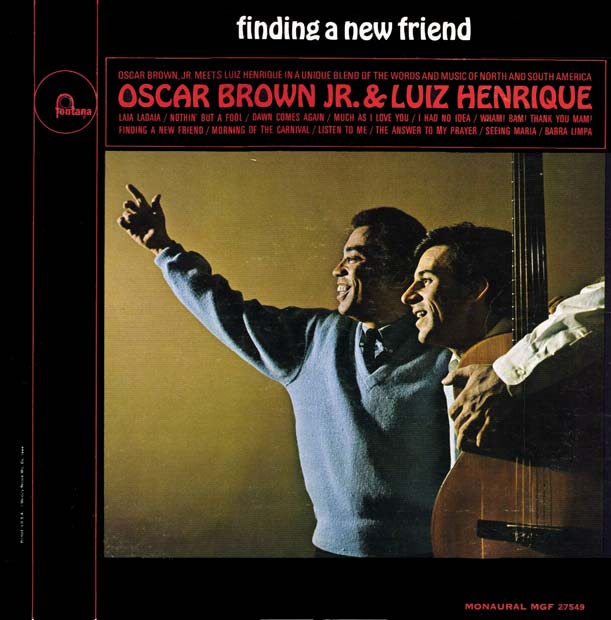
Oscar Brown Jr. & Luiz Henrique

Oscar Brown Jr. & Luiz Henrique - Finding A New Friend Fontana SRF-67549 (1966)

Here's two artists who need no introduction. A rare coming-together by these great vocalists and friends who met at Greenwich Village's Cafe Au Go Go in August 1965. If truth be told, Brown's sly, sardonic vocal style isn't an exact fit for bossa nova; he has to rein himself in for this subtle, almost whispering idiom. But then, the songwriting collaboration works surprisingly well, mostly leaning toward a romantic bossa style, but occasionally hearkening back to Brown's North American hipster persona. And they wander off the territory altogether with Brown's playfully racy bossa calypso, "Wham! Bam! Thank You Mam!".

The album also includes a few Brazilian standards as appetizers before the collaboration begins in earnest. The multi-talented Brazilian Santa Claus, Sivuca, is responsible for three of the soft-focused arrangements, while Henrique takes charge of the rest.

1) Laia Ladaia
2) Nothin' But A Fool
3) Manha De Carnaval
4) Much As I Love You
5) I Had No Idea
6) Wham! Bam! Thank You Ma'm!
7) Finding A New Friend
8) Dawn Comes Again
9) Listen To Me
10) The Answer To My Prayer
11) Seeing Maria
12) Barra Limpa

Tuesday, June 06, 2006

Na Trilha De Osmar Milito

Osmar Milito - Na Trilha De Osmar Milito SOMA 409.6002 (1974)

Noted pianist Osmar Milito is owner of a strong harmonic sense, and has collaborated with amongst others Liza Minelli, Sammy Davis Jr., Pat Metheny, Cláudio Roditi, Hendrik Meurkens, Tony Bennett, Sarah Vaughan, Benny Golson, Spanky Wilson, Mark Murphy and Hermeto Pascoal.

Brother of Hélcio Milito (from the Tamba Trio), Osmar became a professional in 1964, backing Elis Regina, Silvinha Telles, Leny Andrade, Nara Leão, Paulo Moura, Edison Machado, Maria Bethânia, Gilberto Gil, Vinicius de Moraes, and Jorge Ben. After spending a season in Mexico, Milito settled in the U.S. for two years, during which he accompanied Sergio Mendes. Returning to Brazil in the '70s, Milito continued to work with top MPB artists such as Chico Buarque, Ivan Lins, and Nana Caymmi, and instrumental musicians such as Pascoal Meirelles, Márcio Montarroyos, Mauro Senise, and Paulinho da Costa.

I was going to post an individual film score by Milito but this fine album sports tunes taken from several Brasilian Novelas or soundtracks of which he recorded many and ably demonstrates the man's knack for penning hip, catchy and soulful bossas.

1) As Moças (Carinhoso)
2) Encabulada (O Primeiro Amor)
3) Hey Shazam (O Primeiro Amor)
4) Mandato (Selva de Pedra)
5) Corpo Sano Em Mente Sã (Selva de Pedra)
6) O Bofe (O Bofe - Abertura)
7) América Latina (Selva de Pedra)
8) Porcelana, Vidro e Louça (O Bofe)
9) O Primeiro Amor (O Primeiro Amor -Abertura)
10) Podes Crer (O Primeiro Amor)
11) Vou Disparar (O Primeiro Amor)

Tuesday, May 30, 2006

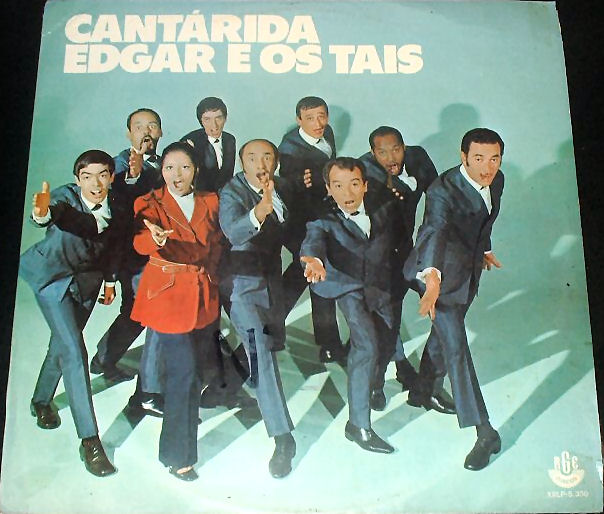
Edgar e Os Tais

Edgar e Os Tais - Cantárida RGE XRLP-5.350 (1970)

Great jazzy vocal bossa led and arranged by Edgar Gianullo and supremely groovy to boot!

Edgar Gianullo (vocal, guitar, bass); Toniquinho (drums); Vicente (bass, piano, organ, percussion); Neneco (vocal, percussion); Nelsinho (vocal, percussion, mouth tuba); Rosely (vocal); Sergio (organ, celeste, bass); Felpudo (trombone, trumpet); Vidal (tenor-sax, flute, piccolo)

1) Estou Dez Anos Atrasado
2) Queen Aparecida
3) Nao Deixo Voce Ir Embora
4) Dela
5) A Primeira Vez
6) Vou Me Pirulitar
7) Prólogo
8) Foi Tao Bacana
9) A Morena Lena
10) Quem Vem La (Vem Balancar)
11) Bambe-Lo
12) Alo-Helo

Monday, May 22, 2006

Fly Cruzeiro

Aquarius Producoes Artisticas - Brazil By Music 'Fly Cruzeiro' (1972)

Here's an absurdly rare promotional record for Brasil's Cruzeiro Airlines on their own label. Mellow yet groovy jazz fusion courtesy Marcos Valle and an early Azimuth incarnation.

1) Jingle Cruzeiro
2) Esta Fazendo Um Ano - Aquarela Do Brasil
3) Zazueira - Mas Que Nada
4) Tristeza
5) Aqui E O Pais Do Futebol
6) Ate Pensei
7) Zanzibar
8) Nao Tem Solucao - Marina - ...Das Rosas
9) Samba De Verao
10) Prenda Minha
11) Asa Branca
12) Wave